

 Call
Call Email
Email
ABCL Heavy Metals Testing &l...
ABCL maintains pharmaceutical-grade purity through rigorous heavy metals testing...
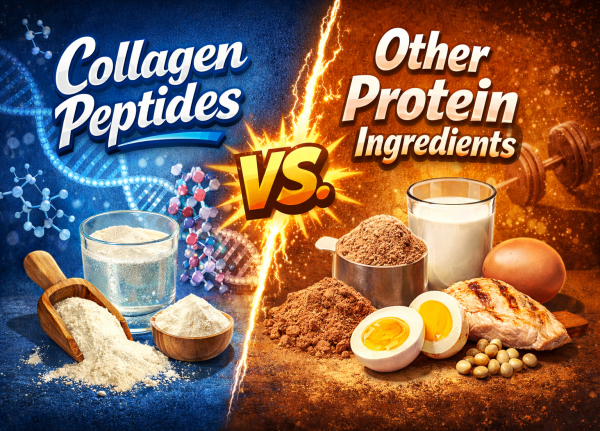
Protein ingredients play a critical role in determining the stability, texture, and sensory profile of finished food and nutraceutical products. While proteins such as whey, soy, pea, and casein are commonly used for nutritional fortification, collagen peptides offer a distinct functional profile that differentiates them from conventional protein sources.
One of the most significant functional advantages of collagen peptides is their low molecular weight and narrow peptide distribution, which results in excellent solubility across a wide temperature and pH range. Unlike many globular proteins, collagen peptides dissolve rapidly without requiring high shear, heat treatment, or pH adjustment, making them particularly suitable for ready-to-drink beverages, instant powders, and clear formulations.
From a sensory perspective, collagen peptides typically exhibit a neutral taste and minimal aroma, allowing higher inclusion levels without negatively impacting flavor. In contrast, plant proteins often introduce bitterness, astringency, or beany notes, while dairy proteins can contribute milkiness or mouth-coating effects that may not align with certain product profiles.
Collagen peptides also contribute unique functional attributes beyond basic protein content. Their ability to enhance mouthfeel, provide light body, and improve texture without increasing viscosity supports clean-label formulation goals. Unlike emulsifying or foaming proteins, collagen peptides integrate seamlessly without altering product appearance or process behavior.
Processing stability is another key differentiator. Collagen peptides demonstrate strong resistance to heat, shear, and acidic conditions, maintaining performance during pasteurization, UHT processing, and spray drying. Many alternative proteins, by comparison, are prone to denaturation, precipitation, or sedimentation under similar conditions.
In finished products, these functional characteristics allow collagen peptides to serve as a versatile, formulation-friendly protein solution, particularly where clarity, stability, and sensory neutrality are essential. As manufacturers increasingly prioritize application performance alongside nutritional value, collagen peptides continue to complement or, in some cases, replace traditional protein ingredients in modern formulations.
Latest Innovations and Insights in Gelatin & Collagen – Empowering Your Industry Knowledge.
ABCL Heavy Metals Testing &l...
ABCL maintains pharmaceutical-grade purity through rigorous heavy metals testing...

The Revival of Gelatin in Mo...
Gelatin-based dishes are returning to kitchens with renewed purpose and creativi...

Industry Confirms Collagen P...
Leading collagen peptide producers from around the world, united through promine...

Grow Defended Flawed Collage...
The Gelatin Research Optimization Working group (GROW), representing global gela...

GROW Study: Gelatin's Unriva...
A landmark international survey conducted by the Gelatin Research Optimization W...


 Read More