

 Call
Call Email
Email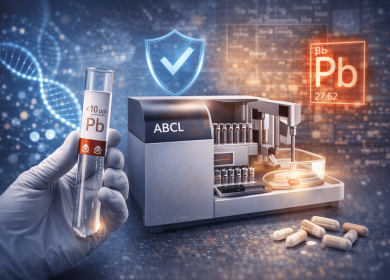
ABCL Heavy Metals Testing &l...
ABCL maintains pharmaceutical-grade purity through rigorous heavy metals testing...
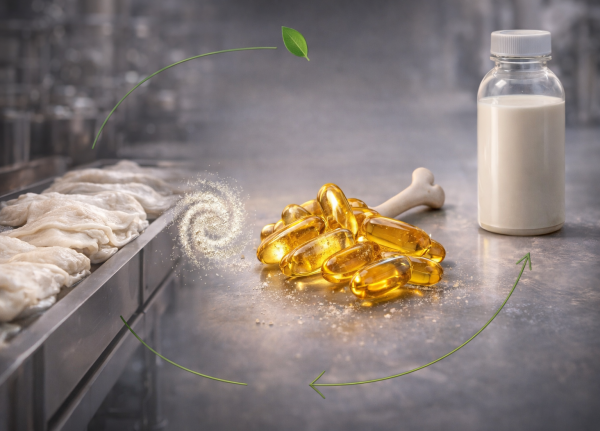
As global population surges past 8 billion, food consumption escalates alongside unprecedented waste generation, creating profound social and environmental challenges. Limited planetary resources demand urgent transformation in food production—from wasteful linear systems to sustainable circular economies. Upcycling emerges as a powerful strategy, converting by-products into high-value ingredients that close production loops and minimize environmental footprints.
Gelatin exemplifies this circular model by definition. Derived entirely from meat, leather, and fish industry by-products that would otherwise burden landfills, gelatin transforms collagen-rich waste into premium functional proteins powering pharmaceuticals, foods, cosmetics, and nutraceuticals. This established upcycling pathway demonstrates how one sector's output becomes another's essential input, creating economic value while slashing waste across interconnected supply chains.
The Gelatin Research Optimization Working group (GROW) recently convened industry leaders, sustainability experts, and innovative startups for an insightful roundtable discussion. Participants examined how food manufacturers can replicate gelatin's proven model amid rising consumer demand for transparency and responsibility. Key themes included scaling upcycled ingredients through strategic partnerships, overcoming technical barriers in novel applications, and aligning production with circular economy principles.
Crucially, the dialogue highlighted necessary shifts in consumer behavior to accelerate adoption. Modern shoppers increasingly prioritize products telling authentic sustainability stories—those reducing waste, conserving resources, and supporting ethical supply chains. Educating consumers about upcycling's tangible benefits, from lower carbon footprints to innovative clean-label solutions, builds trust and drives market pull.
Startups shared cutting-edge approaches: enzymatic processing of vegetable waste into functional proteins, microbial fermentation converting food scraps into high-value nutrients, and precision fractionation unlocking by-product potential. Yet all acknowledged gelatin's foundational role—decades of optimized upcycling proving scalability, safety, and sensory excellence that emerging alternatives must match.
This roundtable crystallized a clear roadmap: food industries must invest in cross-sector collaboration, regulatory alignment, and consumer education to unlock upcycling's full potential. Gelatin's success story provides the blueprint, demonstrating how transforming waste into wealth builds resilient, sustainable production cycles for the future. As circular economy principles gain regulatory and market momentum, upcycling positions food manufacturers not just to survive resource constraints, but to thrive through innovation and responsibility.
Latest Innovations and Insights in Gelatin & Collagen – Empowering Your Industry Knowledge.
ABCL Heavy Metals Testing &l...
ABCL maintains pharmaceutical-grade purity through rigorous heavy metals testing...

The Revival of Gelatin in Mo...
Gelatin-based dishes are returning to kitchens with renewed purpose and creativi...

Industry Confirms Collagen P...
Leading collagen peptide producers from around the world, united through promine...

Grow Defended Flawed Collage...
The Gelatin Research Optimization Working group (GROW), representing global gela...
GROW Study: Gelatin's Unriva...
A landmark international survey conducted by the Gelatin Research Optimization W...


 Read More